
Standard data center builds follow a familiar, often excruciatingly painful script: months of sequential construction, site delays, surprise change orders, and the inexorable scramble to commission systems that had never worked together before. It was a testament to perseverance, but that does not define efficiency.
Moreover, with the rise of hyperscale and ubiquitous edge computing, Time-to-Deployment (TTD) is no longer an ignorable metric. It’s the single most critical factor in achieving ROI, especially when we are under time constraints*. Missing a delivery date by just a quarter can translate to millions in lost revenue.
We believe that embracing modular data center solutions isn’t a shortcut; it’s simply a superior engineering strategy. It replaces chronological risk with parallel execution and chaotic site uncertainty with factory-controlled precision. This isn’t just about speed; it’s about radically lowering the technical and financial risk profile of critical infrastructure deployment.
Here, we unpack the technical differences in the supply chain, logistics, and compliance pathways between traditional “stick-built” projects and the controlled, high-velocity world of prefabricated modular infrastructure.
* Innovation in IT and AI is probably the most dynamic and fast-growing industry we have ever witnessed, with new technology and innovative implementations taking place almost every year or maybe even within months. If you utilize an abundant amount of time (like 1-2 years or more) for construction, you may fall behind on the technology that’s relevant when you are ready to operate.
Stick-Built Challenges: The Timeline Tangles
In traditional construction, the project schedule is fundamentally constrained by the Critical Path Method (CPM), where the completion of one trade’s work is necessary before the next can begin.
Let’s take a retrospective example: foundation pouring must precede steel erection, which must precede wall construction, which must precede the Mechanical, Electrical, and Plumbing (MEP) rough-in. Each of these steps introduces sequential risk. A single weather delay, an issue with any of your material vendors, or an unexpected geotechnical condition can halt the entire project.
The Technical Cost of Sequentialism:
- Supply Chain Inefficiency: A traditional build requires coordinating a Material Take-Off (MTO) involving thousands of individual components: thousands of feet of conduit, specific busbar sizes, hundreds of CRAC unit fan coils, and countless specialized fixtures. Each item is sourced individually and delivered to a potentially exposed and uncontrolled construction site. Tracking inventory, managing storage, and preventing material damage become complex logistical burdens.
- System Integration Risk: The first time the Uninterruptible Power Supply (UPS), the Precision Cooling Units (P-CRACs), and the Power Distribution Units (PDUs) are energized and tested together is typically during the final, high-pressure Site Acceptance Testing (SAT). If a major fault is found, say, a complex control integration error, the rework occurs on the critical path, guaranteeing a schedule slip and incurring significant penalty costs.
- Labor Overlap and Quality Dilution: The site becomes a nexus of competing trade groups (electricians, pipefitters, and HVAC technicians). Quality control is extremely dependent on site-level supervision and the hand-off between trades. Such interceptions lead to variance in build quality and potential gaps between sub-trade interfaces that are only exposed during final commissioning.
Coherently, stick-built relies on assembling complex, integrated systems in the most complicated and least controlled environment possible: an active construction site.
The Parallel Path: How the Modular Approach Smashes the Clock
The core technical advantage of the modular approach lies in decoupling the building construction timeline from the infrastructure manufacturing timeline.
While the site team handles the relatively predictable civil engineering (foundation, utility staging, perimeter security), the technical team is simultaneously building and commissioning the data center infrastructure in a controlled, ISO-certified factory environment. This parallel execution is the key to significant time savings.
The Technical Power of the Factory Acceptance Test (FAT)
This is the single biggest differentiator. For a modular unit, 80-90% of all technical risks are retired before the unit ever leaves the manufacturing floor.
The Factory Acceptance Test (FAT) is a comprehensive, multi-day testing protocol executed by factory engineers, far exceeding the scope of typical site-based checks. It includes:
- Full System Load Bank Testing: The entire electrical system, from the switchgear input through the UPS and PDU outputs, is rigorously tested to its maximum designed load. This verifies all breaker trips, relay responses, and current distribution under actual operating conditions and ambient environments, ensuring true power stability.
- Controls Integration Verification: The Data Center Infrastructure Management (DCIM) and Building Management Systems (BMS) are fully commissioned. This ensures that every sensor, damper, pump, and valve is communicating correctly with the master control system, verifying the performance of complex sequencing (like emergency shutdowns or cooling switchovers) in a calm environment, eliminating last-minute software bugs or other malfunctions.
- Thermal Performance Validation: Cooling systems are tested to ensure they can maintain thermal setpoints at full heat load in a controlled ambient temperature. This proactively eliminates the risk of hidden airflow or insulation issues that would be devastating to find post-deployment.
Crucially, the client or their representative is invited to witness this FAT. Once signed off, the client knows the system works as specified. The SAT on-site is then reduced to a much simpler System Integration Test (SIT), a straightforward verification that the tested module can connect reliably to the external site’s power and network.
This level of technically intensive processes and tests shifts the commissioning risk from the critical path end of the project to the parallel path middle, where remediation is faster, cheaper, and less consequential.
Logistics and The Code Maze for Scalable Modular Data Centers
The benefits of the modular method extend far past the initial construction schedule, creating structural advantages in logistics and regulatory compliance that further shrink TTD and reduce overall risk, particularly for clients seeking scalable modular data centers.
Logistics Planning: Pallets vs. Precision Lift
For on-site constructions, logistics involves managing hundreds of deliveries over many months, requiring large laydown areas and complex, multi-trade material handling protocols. The risks include material theft, weather damage to sensitive components (like batteries), and tracking thousands of inventoried parts.
Modular logistics, by contrast, breaks the project into smaller, simplified parts, into a few predictable, heavy lifts:
- The Single-Point Delivery Advantage: The entire infrastructure, UPS, cooling, power, and security. These components are condensed into one or a handful of transportable units. This allows for just-in-time delivery, minimizing site storage, eliminating material staging areas, and preventing damage to sensitive components from weather or construction traffic.
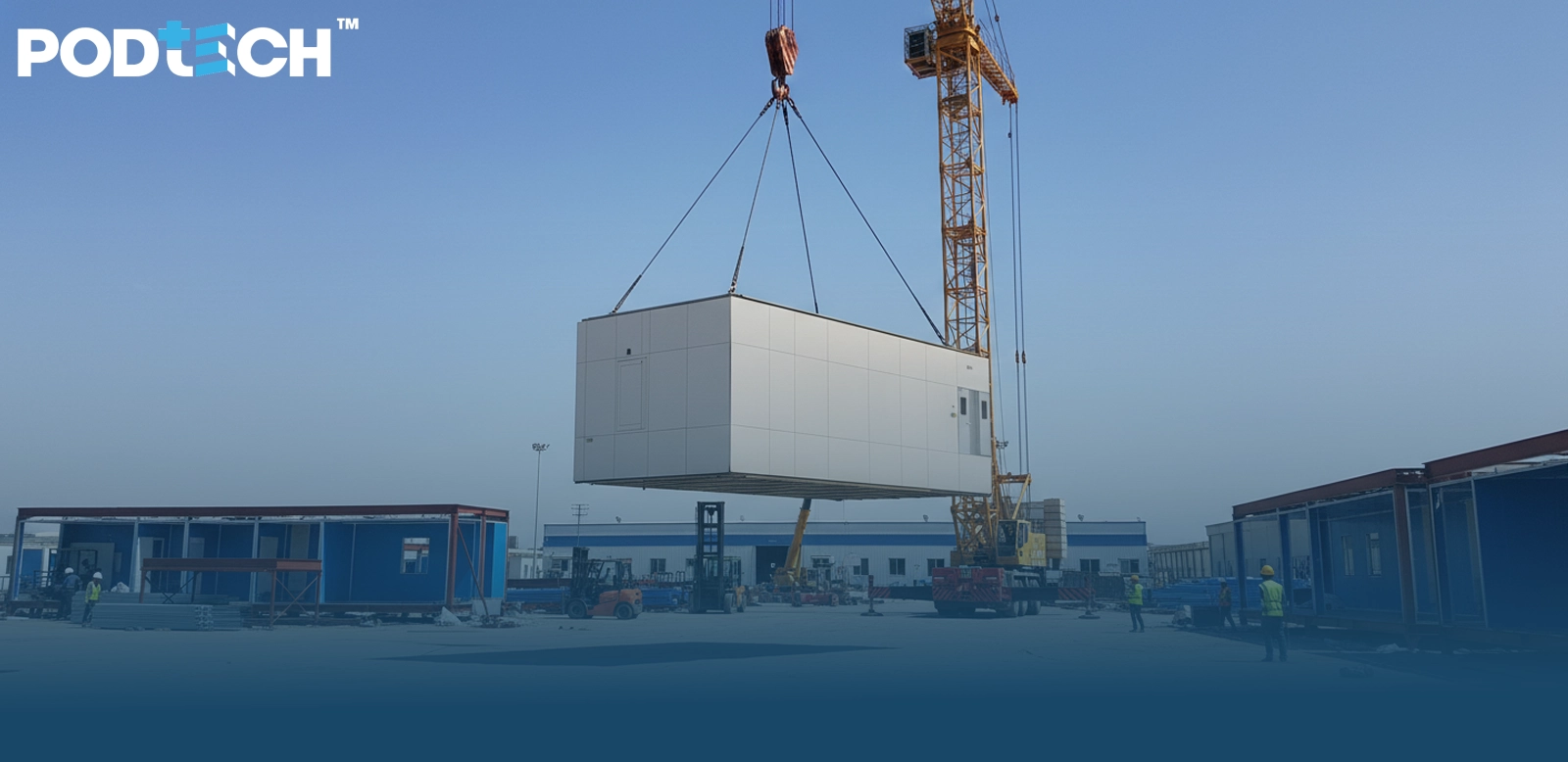
- The Technical Rigging Requirement: Yes, moving a complete, heavy module requires a specialized crane and rigging planning. However, this is a fixed, predictable event with known requirements (crane capacity, site access, path-of-travel) that can be engineered months in advance. The planning effort shifts from managing the chaotic flow of small materials to executing one highly controlled, high-value move. The risk is concentrated but entirely manageable through lift plans and professional, specialist execution.
Navigating the Code Maze with Pre-Engineered Compliance
Local building codes and inspections are a massive variable in any construction project. In a stick-built scenario, final inspections by the Authority are sequential and unpredictable and can lead to time-consuming rework due to differing interpretations of code at the site level.
The Modular data center design and manufacturing process offers a cleaner, pre-vetted compliance pathway:
- Standardized Engineering: Since the modules are standardized and built to globally recognized specifications, the core technical design is pre-vetted and documented across multiple deployments.
2. Pre-Approved Pathways: Many modular manufacturers secure pre-approvals or work through third-party nationally recognized testing labs (NRTLs) to certify the modules against major building codes at the factory level.
- Authority De-risking: By arriving on site with a certified, pre-stamped unit, the local authority’s inspection focuses primarily on the site connection points (utility tie-ins, foundation integrity, and fire suppression tie-in) rather than the complex, internal workings of the infrastructure itself. This drastically streamlines the final code sign-off and reduces the chance of expensive, last-minute infrastructure modifications.
The Takeaway: TTD is a Measure of Technical Confidence
Recognize that TTD isn’t merely about completing a build; it’s about reducing the total duration of technical risk.
By focusing expertise on pre-engineered design, critical FAT protocols, and streamlined logistics planning, the effort is shifted from the unpredictable chaos of the site to the controlled certainty of the factory. This methodology allows entities to deploy critical infrastructure faster, with higher quality assurance, and with a significantly lower risk of budget or schedule overrun.
It’s not just about selling infrastructure; It’s about selling technical confidence and predictable outcomes in a highly unpredictable market.