
The Middle East was synonymous with fossil fuel exports. Today, data is the “new oil,” and advanced, high-tech data centers serve as the modern refineries fueling a monumental economic transition. Backed by strategic geography, sovereign wealth, and progressive government policies, the region is rapidly building a robust post-oil economy.
This transformation is driven by three key pillars: sovereign infrastructure, sustainable engineering, and the edge revolution.
1. The Catalyst: Sovereign Infrastructure & Hyperscale Growth
The current boom in data center construction is largely driven by ambitious “National Visions” that view building localized digital infrastructure as vital to both national security and economic expansion.
- Data Sovereignty First: With privacy taking center stage globally, regional governments are enforcing strict data localization mandates. Sensitive citizen and government data must now remain within national borders rather than in remote international locations. This legal requirement has triggered a massive surge in high-tier facility construction and proactive legal compliance by organizations.
- The Hyperscale Multiplier: The arrival of tech giants like Microsoft, Google, and AWS has turbocharged market growth. By replacing remote, high-latency nodes, these local hyperscalers are lowering entry barriers for startups. Government agencies are migrating old systems to modern, agile architectures and solidifying the Gulf as a premier digital hub connecting Europe and Asia.
- The Hub of the Future: Being the literal center of Europe, Asia, and Africa, the Gulf is now a primary digital hub connecting markets, acting as a “middle ground” for global data traffic.
2. Engineering the Future
Fostering sustainability and building modular edge in a region where ambient temperatures routinely exceed 50°C require rethinking traditional, resource-heavy cooling methods. In these arid climates, traditional air cooling can lead to excessive water and energy consumption. To address these challenges, regional operators are adopting advanced cooling technologies that set new global benchmarks.
- Leapfrogging with Green Tech: Operators are setting global benchmarks by integrating units with advanced cooling systems, which submerge hardware in specialized fluids for maximum heat-removal efficiency. Paired with massive solar integrations, these “green data centers” are crucial for attracting global enterprises with strict ESG requirements. Here are the solutions that the Middle East can use to sustain efficient cooling and generate more energy to support the cooling requirements.
- Liquid-to-Chip & Immersion Cooling: Instead of just air cooling, hardware is submerged in specialized dielectric fluids to remove heat more efficiently.
- Solar Integration: Data center campuses are increasingly being paired with massive solar farms to utilize the region’s abundant sunlight.
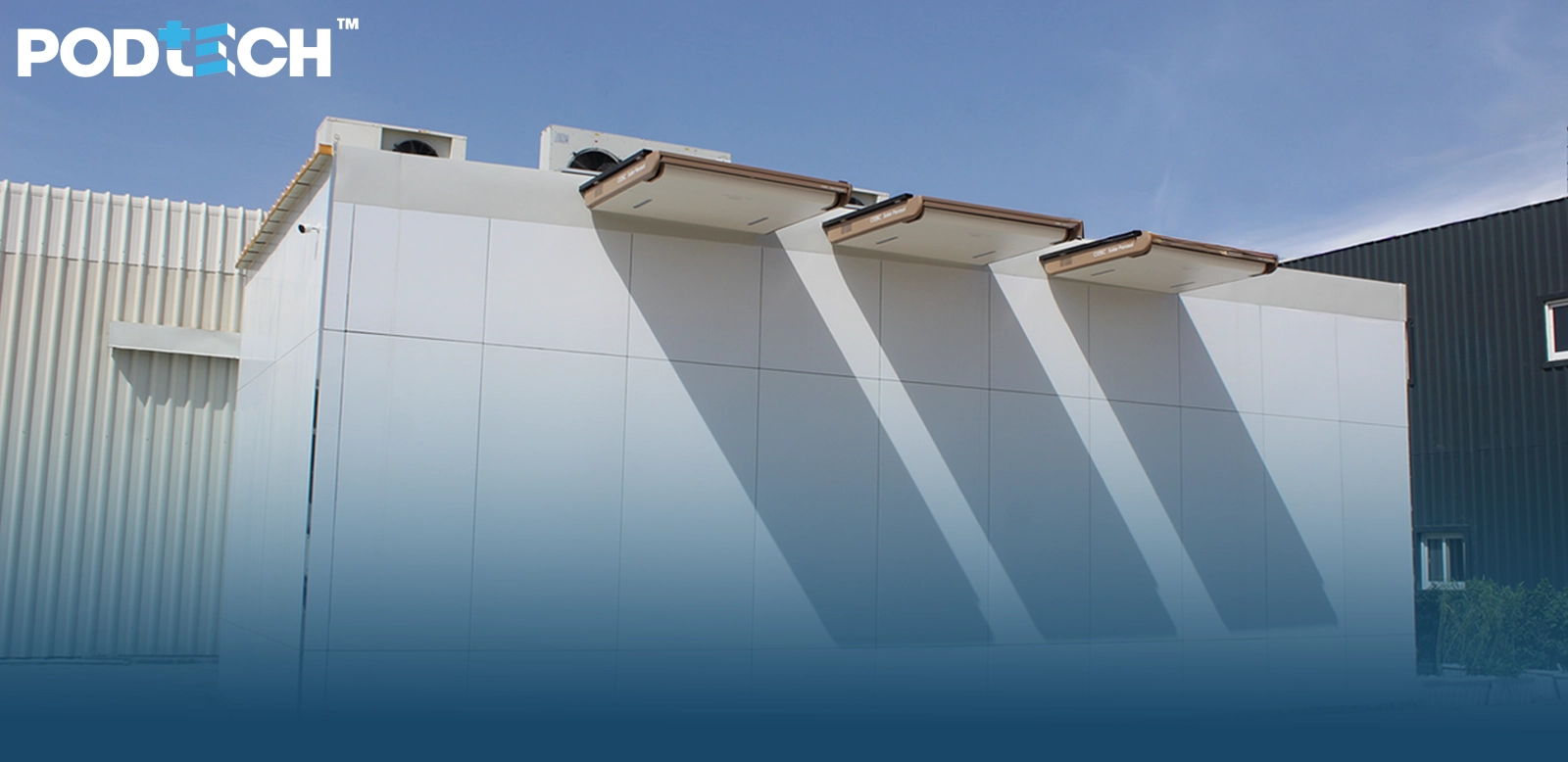
- The Edge and Smart Cities: As the region develops ambitious, ground-up “smart cities,” these projects require a massive web of sensors, autonomous vehicles, and AI-driven public services as they rely on instantaneous data processing. This is driving a massive shift toward a distributed architecture powered by smaller, prefabricated modular data centers positioned exactly at the network’s “edge.” Combined with aggressive 5G rollouts, these modular setups are unlocking the next frontier of urban automation. In order to power these projects, there is the need to move towards a distributed architecture to process data closer to its source.
- ESG Compliance: “Green data centers” help attract global enterprises that have strict Environmental, Social, and Governance (ESG) mandates.
3. Resilience, Connectivity, and the Human Element
As the digital economy matures, the demand for absolute reliability has reached critical levels.
- Landing and Interconnecting: Sitting at the junction of Europe, Asia, and Africa, the region is transforming how subsea fiber-optic cables operate. Instead of just passing through the Red Sea, new cables are landing in multiple regional hubs to create a dense, redundant network that attracts high-frequency trading and media giants.
- Carrier-Neutrality & Tier IV Reliability: Demand for fault-tolerant reliability is pushing the market toward carrier-neutral facilities, giving customers the freedom to connect to multiple network providers, fostering healthy competition, and significantly increasing redundancy. A surge in Tier IV certified data centers ensures that single failures in power or cooling won’t cause downtime. In certain sectors like banking, oil & gas, telecommunications, healthcare, etc., it is mandatory to maintain uptime at all times.
- Hybrid Cloud Dominance: While public cloud is growing, many large government and energy organizations prefer hybrid and private cloud solutions. It is important to remember that infrastructure is only as good as the people who manage it. This allows them to maintain private control of their hardware while leveraging the superior power, cooling, and connectivity of a specialized facility.
- Cultivating Local Talent: It is important to remember that infrastructure is only as good as the people who manage it. To sustain this growth, governments are launching massive national training programs to upskill the local workforce in cybersecurity, cloud architecture, and data center operations. This “localization of talent” ensures this complex expertise remains permanently anchored in the regional economy, creating a sustainable career path for the next generation of engineers, further cementing the data center industry as a permanent fixture of the regional economy.
The Bottom Line
The Middle East’s transition to a data-driven economy is not a future concept; it is a reality being built today. By combining unprecedented capital investment with a “leapfrog” approach to adopting the newest technology from day one, the region has become a critical center of gravity for the global internet backbone.
The Middle East is to transition from a resource-based economy to a data-based economy, considering data as their new oil. For global businesses, the region is no longer just a market to sell to but a critical base for global operations and digital innovation.
In a region defined by ambitious smart cities and real-time industrial automation, minimizing the physical distance between data and the user is a requirement that enables the millisecond precision required for everything from AI-driven logistics to autonomous urban infrastructure. The region’s data centers’ footprint expanding beyond large-scale facilities into modular edge data centers will enable its ability to handle massive data loads of tomorrow, ensuring that its infrastructure is not only sovereign and sustainable but also physically positioned to power the next generation of global commerce.
Based in the Middle East, by providing factory-prefabricated, plug-and-play “podules,” Podtech delivers rapidly deployable edge facilities that offer the infinite scalability and high-density compute necessary to drive regional innovation and digital transformation.