
There was a time, less than a century ago, when the concept of a “data center” wasn’t a global network but a single, massive room that changed the course of human history. This is the story of how a “data center” became what we know it as today.
To understand the origin of the data center, let’s look back to the mid-1940s, an era defined by the smoke of World War II and the looming shadow of the Cold War. This is the story of the ENIAC, the birth of the mainframe, and the moment humanity first learned how to house a “Giant Brain.”
The Birth of the ENIAC: A Military Necessity
In the early 1940s, the United States military faced a monumental mathematical crisis. Artillery fire requires complex calculations involving wind speed, air density, temperature, and distance. During the war, these “firing tables” were calculated by hand by hundreds of people (who were mostly women) known as “computers.” However, the human pace was too slow for the rapidly evolving theater of war.
The solution was the Electronic Numerical Integrator and Computer, or ENIAC. It was designed by John Mauchly and J. Presper Eckert at the University of Pennsylvania’s Moore School of Electrical Engineering. The ENIAC was the world’s first electronic digital programmable general-purpose computer. Though commissioned for the war effort, the ENIAC was not completed until late 1945, missing the final battles of World War II.
However, its purpose shifted immediately. Instead of just calculating artillery trajectories, its first real-world application was a terrifyingly high-stakes project. It was a feasibility study for the thermonuclear weapon (the hydrogen bomb). This transition from ballistics to nuclear physics signaled that the ENIAC’s purposes were more versatile than being a calculator.
The Physicality of a 27-Ton Giant
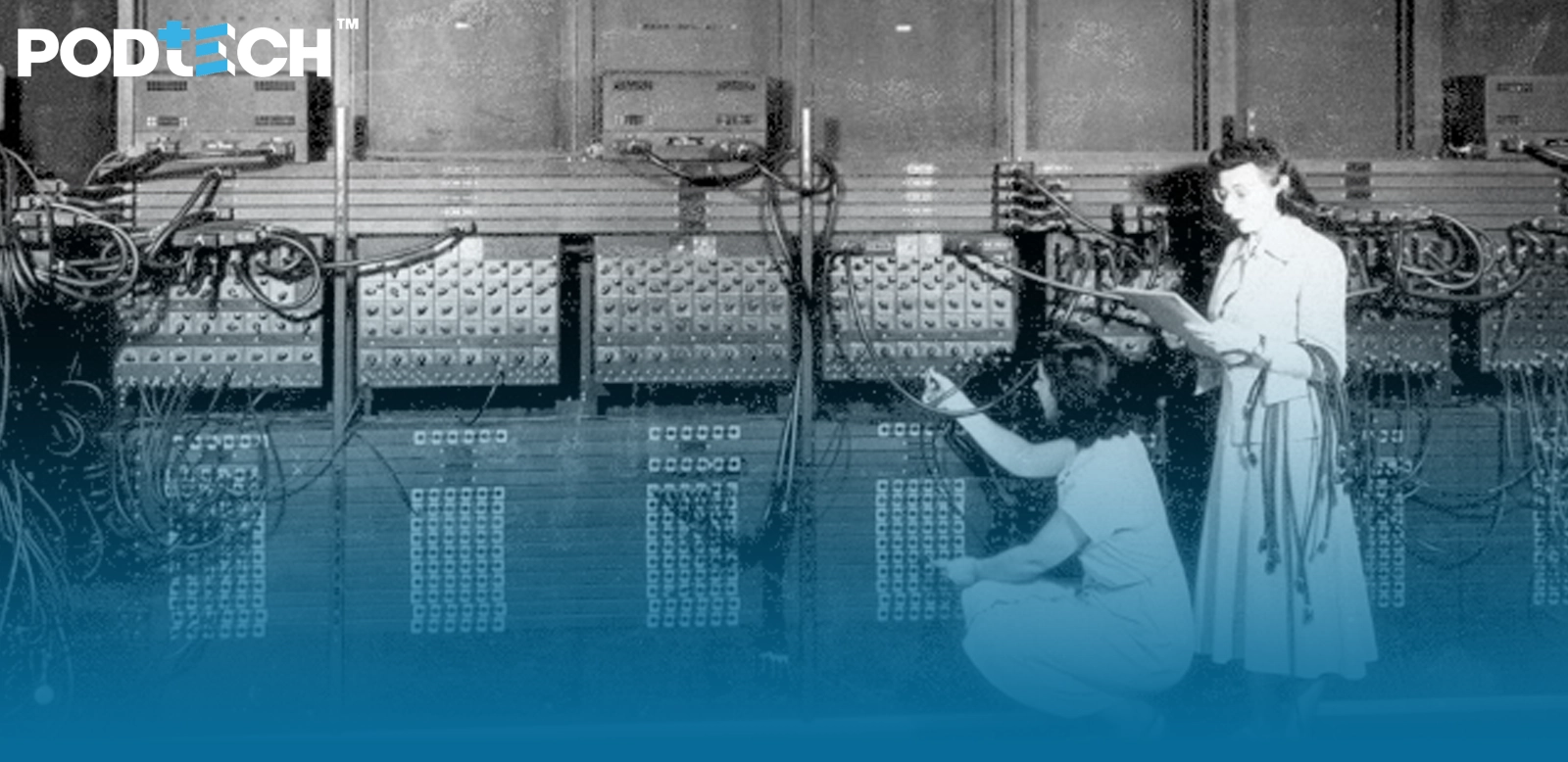
If you were to walk into the ENIAC mainframe (the first iteration of a data center) in 1945, you wouldn’t see sleek racks of servers. The ENIAC was the goliath of engineering that weighed more than 27 tons. It weighed approximately the same as five adult elephants. It occupied 1,800 square feet of floor space, arranged in a U-shaped series of 40 individual panels.
Inside this massive frame lived the “organs” of the first digital brain:
- 18,000 Vacuum Tubes: These were the precursors to the modern transistor. They glowed like lightbulbs and were responsible for the ENIAC’s speed.
- 70,000 Resistors and 10,000 Capacitors: These managed the flow of electricity through the system.
- 1,500 Relays and 6,000 Manual Switches: Programming the ENIAC didn’t involve typing code. It involved physically flipping switches and plugging in patch cables, similar to the functioning of an old-fashioned telephone switchboard.
Data storage in this era was equally physical. The ENIAC lacked internal memory for programs. Instead, it utilized punch cards, which were stiff pieces of paper where holes represented data points. Feeding these cards into the machine via IBM card readers was a labor-intensive process, making this early computing environment a place of constant physical movement.
Creating the First “Mainframe” Environment
Because the ENIAC was so massive and complex, it couldn’t simply be placed in a standard office. It required a dedicated facility for the machine. In 1945, the University of Pennsylvania established what is widely considered the foundational blueprint for the world’s first data centers.
The term “mainframe” originally referred to the large metal frames that held the central processing units of these early computers. As these machines became the centerpiece of institutional operations, the rooms that held them became the blueprints for the modern data center.
By the 1950s, the success of the ENIAC led the U.S. government to build additional dedicated facilities. These were high-security installations. Locations were established at Aberdeen Proving Ground, the Pentagon, and even the headquarters of the newly formed CIA. Because these machines were processing the nation’s most sensitive defense and intelligence data, from nuclear codes to espionage logistics, the concepts of “data security” and “physical perimeter control” were born.
The Problem of Heat: The First Cooling Systems
One of the most significant legacies of ENIAC’s first home was the invention of data center cooling. Imagine 18,000 vacuum tubes running simultaneously. Each one of those tubes generated heat, much like an incandescent lightbulb. When you pack 18,000 of them into a dedicated room, the temperature rises rapidly.
The ENIAC generated so much heat (around 150 kilowatts of power) that it could easily have melted its own components or started a fire if left unchecked. To prevent a catastrophe, the first installation had to be engineered with massive industrial exhaust fans and specialized ventilation systems. Engineers had to constantly monitor airflow to ensure that the ENIAC didn’t suffer a thermal breakdown.
This was the birth of environmental control as a critical component of computing. Today, we spend millions of dollars on liquid cooling and “cold aisle” containment, but the fundamental challenge remains the same as it was in 1945, how do you keep a powerful machine from burning itself alive?
The Shift to the 1950s: Expansion and Evolution
As we moved into the 1950s, the footprint of the data center began to evolve. The lessons learned from the ENIAC at the University of Pennsylvania were applied to newer installations like the UNIVAC I. These facilities became more sophisticated, moving beyond the “experimental” phase into a permanent part of the American infrastructure.
The secrecy surrounding these early hubs cannot be overstated. During the height of the Cold War, the ENIAC was a target. If an adversary could disrupt the mainframe, they could blind the military’s ability to calculate trajectories or analyze intelligence. This led to the development of redundant power supplies and fire suppression systems, features that remain industry standards today.
The Legacy of the 27-Ton Brain
It is difficult to reconcile the image of the 27-ton ENIAC with the smartphone in your pocket, which is millions of times more powerful and fits in the palm of your hand. However, the lineage is direct. The ENIAC proved that electronic calculation was possible, and the University of Pennsylvania proved that such machines needed a specialized environment to survive.
This mainframe taught us four critical lessons that still govern the IT world today:
- Scale: Computing power requires physical space and organized infrastructure.
- Thermal Management: Machines generate heat, and airflow is as important as electricity.
- Security: Data is a valuable asset that must be protected by walls, vents, and guards.
- Purpose: Computers are not just for math; they are for solving the most complex problems of humanity, from ballistics to the mysteries of the atom.
When we look at the gargantuan data centers operated by Google, Amazon, or Microsoft today, we are looking at the grandchildren of the ENIAC’s original room. We have replaced vacuum tubes with silicon chips and punch cards with fiber optics, but we are still building “mainframes” in dedicated halls, still fighting the battle against heat, and still relying on these digital cathedrals to power our world.
The story of the ENIAC shows that from the very beginning, the “mainframe” was never just about the computer. It was about the environment built to sustain it. While we have spent decades refining those “digital cathedrals,” the next chapter in this lineage is moving away from permanent, rigid rooms and toward the factory precision of Modular Data Centers. Just as the ENIAC proved that human knowledge needed a dedicated home, Podtech proves that the modern “Giant Brain” no longer needs to be tethered to a fixed location, offering a rapidly deployable, infinitely scalable infrastructure that honors the 27-ton giant’s legacy by finally mastering the challenges of heat, space, and scale in a single, portable pod.