
Key Security Benefits
Local compute keeps sensitive data within a defined physical perimeter, eliminating the transmission window where interception can occur.
Modular enclosures function as self-contained security perimeters, independent of the physical security posture of the surrounding facility.
Physical segmentation between edge nodes structurally limits lateral movement, containing the blast radius of any single compromise by design.
More locations means more endpoints, and more endpoints means more exposure. That is the objection. It is understandable, but it rests on the wrong model of what a modern modular edge data center actually is.
When the enclosure itself is the security perimeter, when compute is local, when WAN traversal is minimal, and when physical segmentation is built into the architecture by design, the equation changes entirely. Distributed infrastructure, done correctly, shrinks the attack surface. It does not grow it.
The Case Against the Centralized Default
Centralized architecture has sound infrastructure logic behind it: one facility to physically secure, one network perimeter to manage, and one environment for operations teams to maintain. For organizations with workloads concentrated in a single geography, that model delivers exactly what it promises.
Where the design introduces constraints is in how it handles data generated at distributed sites. Raw operational data from field locations, remote facilities, and production environments must traverse wide-area networks to reach central compute resources, crossing infrastructure segments that the owning organization does not directly manage. For multi-site operations with high data volumes or residency requirements, that transmission distance is an infrastructure variable worth examining alongside performance, latency, and fault containment considerations.
Local Compute Eliminates the Most Exposed Transmission Window
Data that is processed at the point of origin does not need to travel across external networks to be acted on. In a secure edge computing architecture, compute resources sit at or near the source of data generation. Sensitive workloads run locally. What eventually reaches a central repository is processed output, not raw operational data moving unprotected across a wide-area network.
For industries with strict data residency obligations, this carries compliance weight as much as security weight. Healthcare organizations handling patient data, financial institutions processing transactions, and industrial operators managing proprietary process telemetry all benefit from a model where sensitive data stays within a defined physical and jurisdictional perimeter. The data lives in an environment you control, processed by infrastructure you own, without passing through shared carrier networks that serve dozens of other customers.
PodTech modular enclosures are built to support this model directly. Each enclosure functions as a self-contained compute environment capable of handling local workloads without requiring constant connectivity to a central system. That sovereignty over local data processing is the foundation of a genuinely defensible edge security architecture.
Modular Enclosures as Self-Contained Security Perimeters
Physical access to hardware remains one of the most direct paths to a serious breach. Software controls, encryption, and network monitoring all matter, but they matter less when someone can physically reach the hardware itself. This is where conventional remote deployments have historically failed. Equipment placed in a satellite office or field location typically depended on the physical security posture of the surrounding building, which ranged from solid to essentially nonexistent.
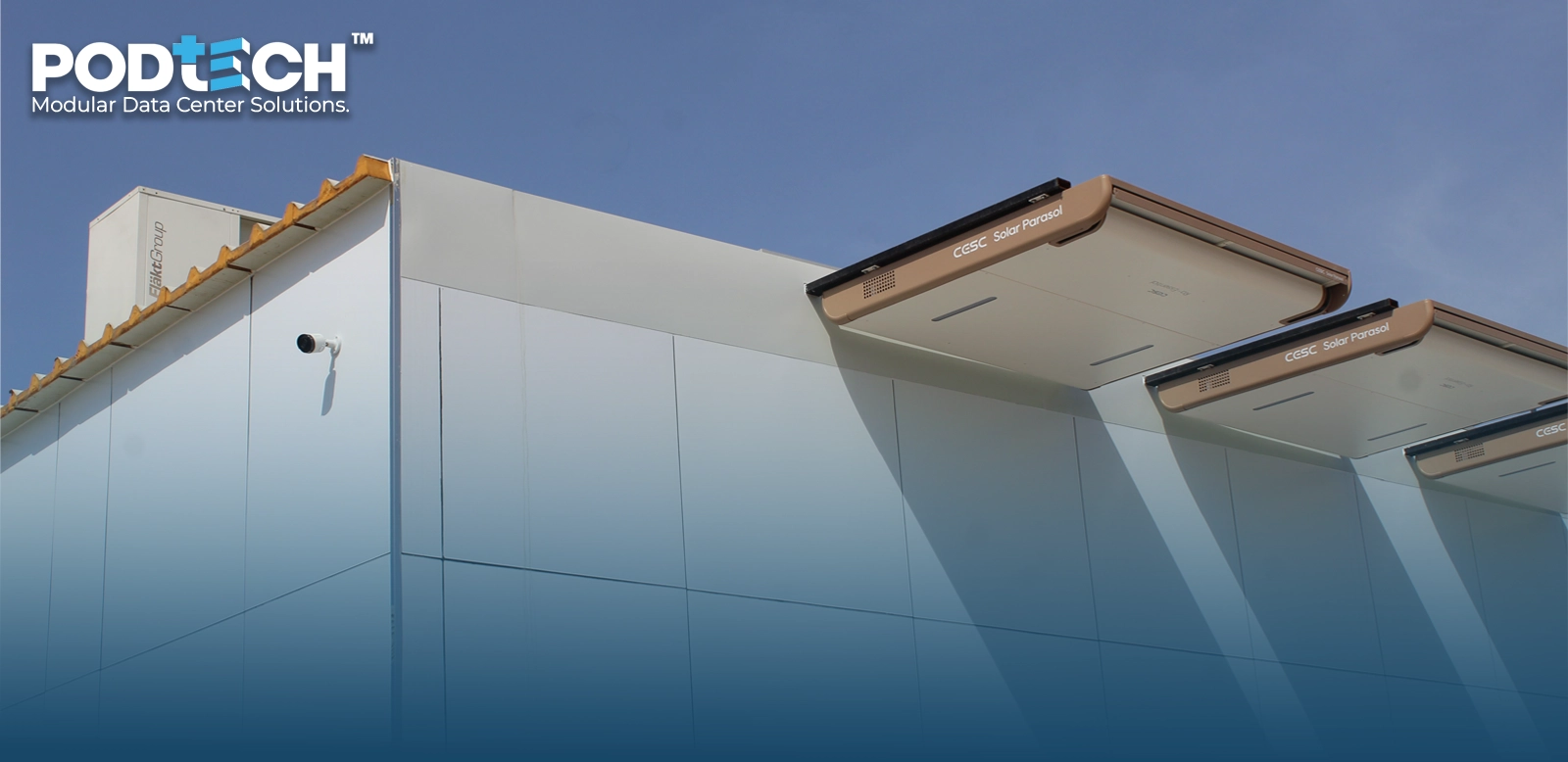
Modular edge data centers resolve this by making the enclosure itself the security perimeter. PodTech enclosures are engineered with multi-factor access controls, tamper-evident construction, and continuous environmental monitoring integrated into the unit rather than added as an afterthought. The level of physical protection the hardware receives is determined by the enclosure design, not by whoever manages the building it sits inside.
This matters most in environments where physical access to the surrounding space is shared with people who have no legitimate reason to interact with compute infrastructure: industrial facilities, logistics hubs, retail environments, and telecommunications sites. A sealed, monitored enclosure with its own access control and audit logging removes hardware exposure from the equation entirely, regardless of who else is in the building.
Tamper detection and access logging from the enclosure also simplifies audit and compliance reporting. When regulators or internal auditors ask whether unauthorized physical access to hardware is possible, the answer comes from documented enclosure telemetry rather than from a subjective assessment of facility security.
Distributed Infrastructure Security Through Physical Segmentation
Segmentation limits how far a compromise can spread, and edge architecture enforces it at the infrastructure level rather than the software layer. In centralized architectures, segmentation is primarily a software-layer problem. VLANs, firewall rules, and micro-segmentation solutions all work to create logical boundaries within a shared physical environment. Those controls require careful configuration, ongoing maintenance, and regular auditing to remain effective.
Edge architecture introduces physical segmentation that does not depend on software configuration to remain in place. Each modular edge data center handles the workloads for a specific location or function. The hardware is separate. The local network environment is distinct. Traffic between edge nodes crosses defined, monitored links rather than flowing freely across a shared internal network.
The practical consequence is a meaningfully reduced blast radius. A security incident at one edge node affects that node’s local environment. Moving laterally to workloads at another location requires crossing a boundary that can be monitored, throttled, or severed. That containment property is structural rather than configured, which makes it considerably more reliable under real incident conditions when configurations can be bypassed or overwhelmed.
Sovereign Infrastructure and Reduced WAN Dependency
Sovereign infrastructure means compute and storage resources that operate under your direct control, in a defined physical location, without depending on third-party infrastructure to function. This is the operating model that PodTech enclosures are built around.
Reduced WAN traversal is part of that sovereignty. When edge nodes handle local workloads independently, the volume and sensitivity of data crossing wide-area networks decreases substantially. Backhaul to central systems carries aggregated or processed output rather than raw operational data. The number of network hops that sensitive information crosses goes down, and with it, the number of external surfaces where traffic could be analyzed, captured, or disrupted.
Operational continuity under connectivity disruption is a secondary benefit that carries security implications. An edge node that can operate independently during a WAN outage is also an edge node that continues functioning during a denial-of-service event targeting the connection between the edge location and the central facility. Sovereign local compute is resilient compute.
Reframing the Question Security Teams Should Ask
The relevant security question is not how many locations an architecture involves, but what an attacker can actually do if they gain access to any given point in the environment. Those numbers matter, but they are secondary to that more important question.
A single centralized facility with exposed transmission paths, inadequate physical controls at remote collection points, and a flat internal network may have fewer locations while carrying greater real-world risk. A distributed edge deployment built on modular enclosures, with local compute, physical segmentation, and sovereign infrastructure at each site, provides meaningful defense in depth that is structural rather than configured.
PodTech builds modular edge data centers for exactly this environment. The enclosures exist to bring enterprise-grade compute infrastructure to locations that have historically lacked it, without the physical and operational security compromises that earlier remote deployments required. Should distributed infrastructure be a part of your organization’s plans, and if the main consideration in choosing this option is security, this point requires further discussion since the technology under examination might prove to be much more secure than your current setup.
Frequently Asked Questions
Is edge data center security weaker than centralized data center security?
Not when the infrastructure is designed correctly. It is a misconception that having more locations makes things less secure when we’re talking about purpose-designed, hard-wired, and physically secured modular enclosures, not random remote hardware. A modular edge data center with its access management system, local computing capacity, and network segmentation can provide much higher levels of security compared to centralized environments with open and potentially vulnerable transmission channels and flat networking.
What does secure edge computing actually mean in practice?
Secured edge computing is essentially an approach in which computing resources are deployed closer to where the data originates, in a secure modular structure, and with sufficient local processing power to minimize reliance on wide area networks.
How does a modular edge data center minimize the damage from an attack?
Each modular edge data center handles workloads for a specific location or function in isolation. The hardware is physically separate from other nodes. Network connectivity between sites crosses defined, monitored links rather than a shared internal network. If one node is compromised, an attacker cannot move laterally to workloads at another location without crossing a boundary that can be detected and severed. That containment is structural rather than dependent on software configuration remaining intact under pressure.
Why is physical segmentation in edge architecture more reliable than logical segmentation?
Logical segmentation through VLANs, firewall rules, or micro-segmentation tools depends entirely on those configurations remaining correct and enforced over time. Misconfigurations happen, rule sets drift, and software controls can be bypassed. Physical segmentation between edge nodes exists at the infrastructure level. Hardware in separate enclosures in separate locations is separated by geography and monitored connectivity links. That boundary does not disappear because of a misconfigured rule.
What is sovereign edge infrastructure and why does it matter for security?
Sovereign edge infrastructure refers to compute and storage resources that operate under direct organizational control at a defined physical location, without relying on shared third-party infrastructure for core functions. For security, this matters because it removes dependency on carrier networks and shared facilities that serve other customers. The data processing is done locally, using hardware under your ownership, from a site controlled by you, without being routed over any third-party infrastructure outside your control. That directly reduces exposure during both normal operations and connectivity disruptions.
How do modular enclosures enable audit and compliance?
Modular enclosures with built-in logging and monitoring give you documented evidence for every time there was an access to the hardware, a temperature variation, or any tampering attempt. It is much more substantial when auditors demand that there be proof that physical access into the infrastructure is not only restricted but also monitored, rather than having to rely on a facility audit which may involve security mechanisms beyond your direct control.
Can edge infrastructure continue operating securely during a WAN outage?
Yes, here is an excellent operational reason why there needs to be compute at the edge. A decentralized edge data center that performs its workload locally is still operational even in cases where the connection to its main facility is interrupted. Processing will continue, storage access will continue, and uptime is maintained at that facility. Security-wise, the edge facility will also remain functional in the case of a denial-of-service attack on its WAN connection, which is significant in situations where connectivity cannot be taken for granted.