
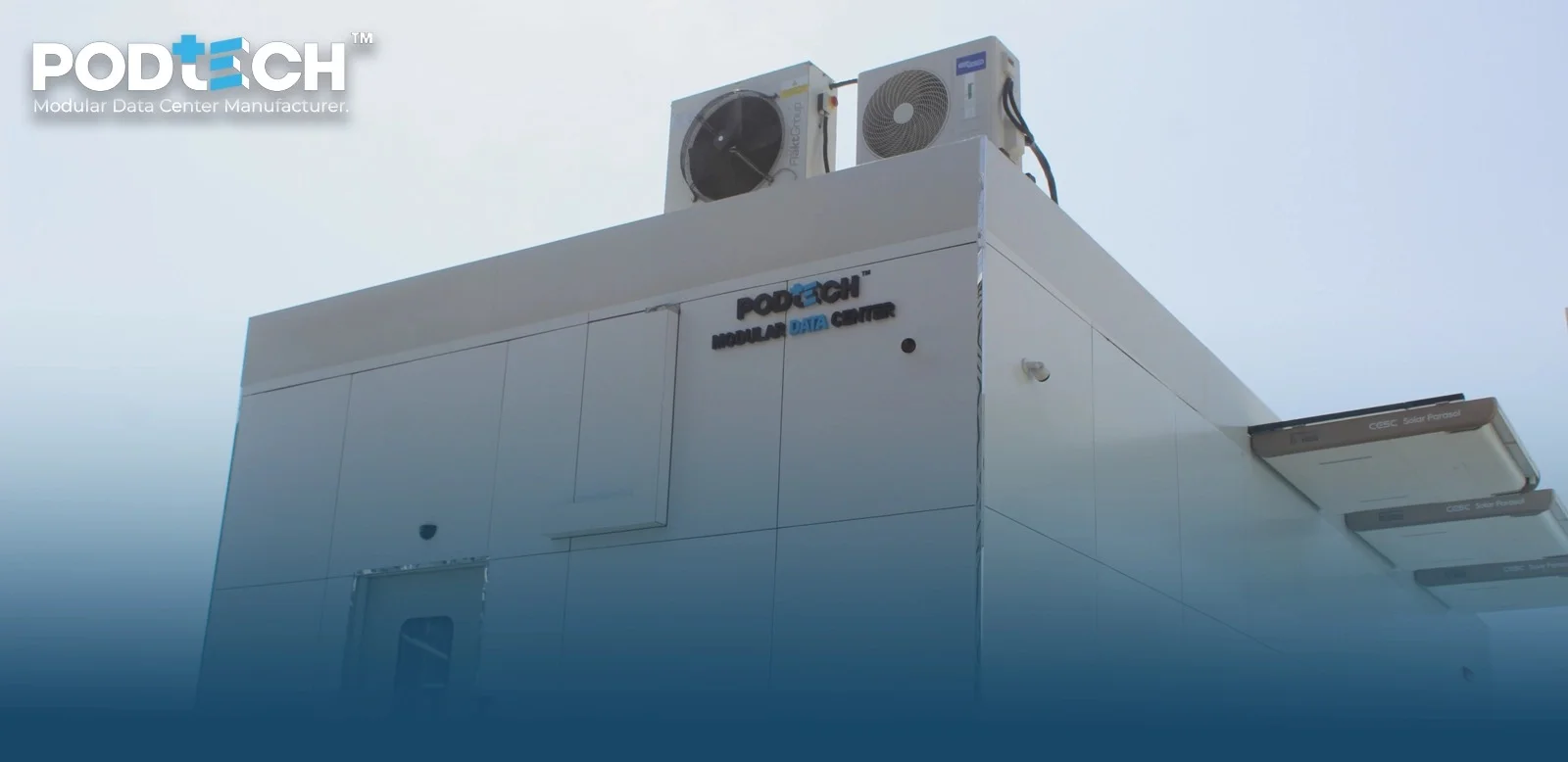
Edge Computing entails analyzing and processing information physically near where the data is generated, be it in the factory premises, in a retail store, or a cell tower, and not sending all the data back to a remote centralized data center or cloud. They are prefabricated, factory-built facilities using standardized equipment, including electricity, cooling, IT rack, and security systems, and delivered on-site for quick installation, usually within six to eight months instead of years.
We spend a significant amount of time at PodTech Data Center speaking to operators, network engineers, and IT managers looking to determine where to locate their compute. The discussion inevitably returns to these two concepts, edge and modular. This is how we think of them and the relevance they have today.
What edge computing actually means
For most of the last two decades, computing followed a simple pattern. Devices collected data, sent it to a centralized data center or cloud region, and waited for a response. That pattern worked fine when the bottleneck was storage or raw processing power. It stops working as well when the bottleneck is time.
A self-driving vehicle cannot wait 200 milliseconds for a cloud server in another region to tell it whether to brake. A factory sensor monitoring a turbine cannot afford a delay when detecting a fault. A hospital running real-time patient monitoring needs answers in the room, not after a round trip to a data center hundreds of kilometers. Edge computing is able to address this problem by bringing the computational power closer to where the information originates from. This allows local compute nodes to do the necessary computations without the need to send all data to the central point.
The cloud remains an important part of this whole concept, as centralized infrastructure is responsible for the tasks related to the long-term data storage, heavy training, and coordinating actions among the various sites.
Why is this shift happening now?
A few forces are pushing edge computing from a niche idea into a mainstream requirement.
The first is data volume. There is now more data generated by sensors, cameras, and interconnected devices than the networks can practically transport to a central place. Transmitting all the frames of videos from each retail store to a regional cloud is expensive and time-consuming. Processing that video where it is captured and sending only the relevant events upstream is far more practical.
The second is AI inference. Training large models still happens in massive centralized facilities. Inference, meaning the process of executing such models on live data, requires to be done closer to the end-user or the end-device for efficiency reasons. Voice assistants, quality control cameras on assembly lines, or fraud detection systems at point of sale devices would all profit from inference that takes just milliseconds instead of seconds.
The third is regulation and data sovereignty. Many industries and countries now require certain data to stay within a specific region or even a specific facility. Distributed edge sites make this kind of compliance far easier to manage than a handful of massive regional clouds.
The fourth is 5G and improved connectivity. Faster wireless networks are only as useful as the infrastructure behind them. Telecom operators are placing compute resources at cell sites and regional hubs so that low-latency promises made by 5G can actually be delivered to end users.
There is also a straightforward cost argument. Data transmission over vast distances is resource-intensive because bandwidth costs money. Every gigabyte that flows out of the shop, the factory, or the car over to the distant location contributes to the growing network expenses. Processing data closer to its source and sending only what matters upstream reduces that ongoing cost, which is part of why finance teams have started paying attention to edge strategy alongside IT teams.
Where modular data centers come in
Here is the practical problem with edge computing: you need infrastructure in dozens, sometimes hundreds, of locations. Construction of an ordinary data center in every place is unrealistic because it will take between eighteen months and two years, or even more, to construct it; specialized builders are needed; the size of the facility has to be significant enough.
The solution provided by modular data centers is the movement of construction from the construction yard to the factory floor. In this way, the power supply, cooling system, racks, and security systems are constructed and tested at the factory level before being deployed. Once the modules arrive, assembly typically takes six to eight months (depending on IT equipment lead times) rather than years.
For edge computing, this is important because edge computing deployments, by definition, have to be distributed. A company that has 500 stores, for example, or a telecom company with regional towers or an industrial firm with a number of factories, can’t afford to wait for several years in order to get closer to their sites.
The benefits go beyond speed
Speed of deployment gets most of the attention, and it deserves it. Industry data consistently points to schedule reductions of 40 to 50 percent when comparing modular builds to traditional construction. For an organization racing to support AI workloads or expand regional coverage, that difference can decide whether a project ships this year or two years from now.
Speed is one part of the story. Standardization is another. The deployment speed is where the focus is put, and justifiably so. According to industry reports, modular construction leads to schedule savings of up to 40-50% compared to conventional construction. In case the company is trying to accelerate deployment of AI applications or geographic expansion, this is what will determine whether the project gets done this year or in two years.
Scalability plays a role too. The modular building can begin with just one module which caters for a regional office and then keep expanding with more units according to demand. This strategy ensures that the organization does not make the mistake of overbuilding capacity that is never used for years or underbuild and run into limitations after a few months.
Cost predictability matters as well. Since the modules are made in the safe environment of the factory, the prices remain stable as compared to custom building construction, where unforeseen costs arise halfway during the construction process.
Energy efficiency and sustainability are becoming more talked about. Factory-built modules can be designed with energy efficiency and power management from the beginning, instead of retrofitting them. Some players have decided to combine their modular approach with renewable energy sources or liquid cooling systems to handle the density created by the workloads of AI systems.
How this plays out across industries
Factory production uses edge computing nodes inside modular units to track equipment performance in real time, preventing any mechanical failures. The data gathered through sensors is analyzed by local computers, detecting anomalies without the need for a central analysis report.
Edge computing helps healthcare professionals perform image and patient monitoring processing at the location where treatment is administered. This is critical since any delay can result in serious problems and will allow healthcare institutions to maintain compliance with local regulations regarding patient data.
Retailers use edge computing in order to track their inventories, run security cameras, and have working point of sale systems despite temporary disconnection from the main system.
Financial institutions running automated trading or fraud detection depend on inference that happens in a few milliseconds. Sending that data to a distant cloud region and waiting for a response is not fast enough for these use cases, so compute needs to sit close to where transactions occur.
Telecom operators are perhaps the clearest example of edge and modular infrastructure working together. As they roll out 5G, they need compute at cell sites and regional hubs, often in locations with limited space and no existing data center footprint. Modular units are frequently the only realistic way to add that capacity quickly.
Utilities and energy providers are another growing example. Data from grid monitoring, smart metering, and renewable energy plants comes continuously and consistently from sensors that cover large geographic spaces. Processing the data locally helps to detect any equipment failure or instabilities within the power grid on the fly, rather than finding out that something is wrong when it is too late and leads to an outage. Similar dynamics occur with smart city initiatives – distributed compute is used to handle data from traffic management systems, surveillance cameras, and various environmental sensors.
What to consider before deploying
Edge and modular infrastructure solve real problems, but they come with their own set of decisions to work through.
Power availability at remote sites is often more limited than teams expect, so planning for backup power and efficient cooling early avoids costly redesigns later. Physical security matters more at distributed sites than at a single large facility, since there are simply more locations to protect. Remote management and monitoring tools become essential when staff cannot be on-site at every location around the clock. Network connectivity between edge sites and central systems needs to be reliable, since these small facilities still depend on links back to core infrastructure for coordination and backup.
None of these are reasons to avoid edge and modular deployment. They are simply part of planning it properly, and organizations that account for them early tend to see smoother rollouts.
Where things are headed
The numbers prove what is said above. The global market of edge data centers was valued at USD 14.8 billion in 2025, and this number is expected to reach USD 51.3 billion by 2034, with a CAGR of 14.35% for growth period of 2026-2034. This growth is enabled by the growing requirement for hyperscale and multi-cloud data centers, with the push for AI and ML for real-time data processing needs, as stated by iMARC’s Edge Data Center Market Size and Share Report.
Here at PodTech, we see edge computing and as two sides of the same shift. Edge computing is the reason organizations need to compute in more places. Modular construction is how they actually get it there without waiting years or overspending on custom builds. Understanding both concepts and how they support each other is becoming a basic requirement for anyone planning infrastructure over the next few years.
These kinds of companies begin their process with the work, not the building, mapping out where information is generated, the time factor of a response, and the impact if a link to a central facility goes down for a few minutes. It all influences the thinking on sites, module size, power backup, and the extent of localized vs centralized processing within the cloud region. And this kind of infrastructure planning tends to age far better than planning based on the floor plan over the next five to ten years.
Frequently Asked Questions
What is the simplest way to explain edge computing?
Edge computing is computing done closer to the source of creation of data rather than moving all of it to the remote data center. Consider an example of a camera that can detect movements by itself without moving each and every frame to the cloud server for processing purposes.
How is a modular data center different from a regular data center?
While traditional data centers are constructed on site from scratch, which takes time and involves a huge number of people working on the project, modular data centers are built in pieces in a factory, tested there, transported to the site and installed.
Do edge computing and cloud computing compete with each other?
Far from it. They perform different functions in one task. Cloud computing serves best when it comes to storage, intensive computing, and orchestration. Meanwhile, edge computing manages those functions that require an immediate reaction such as spotting defects in manufacturing or sensor readings. In the end, almost all firms have to use both of them simultaneously.
Why are companies suddenly interested in edge computing?
A combination of things is driving it. There is more data being generated by sensors and cameras than networks can efficiently move to a central location. AI models need to run close to users for quick responses. Regulations in some industries require data to stay in a specific location. And 5G networks only deliver on their speed promises if compute is close enough to take advantage of them.
Can a small business benefit from modular data centers, or is this only for large enterprises?
Small businesses also gain from this strategy as they might be able to get started on a small scale and expand later. A local retailer or a manufacturing company does not have to invest in a huge building since they can begin operations with a smaller modular deployment.
How long does it usually take to deploy a modular data center?
The timeline will differ based on preparation and permits, but a modular deployment project normally takes anywhere between six and eight months after the components are manufactured, while a regular project takes longer than eighteen months.
What industries rely most on edge computing today?
These include manufacturing, healthcare, retail, financial services, and telecommunication sectors that use modular computing the most. These are businesses that have workloads that require immediate local computation; it could be monitoring machinery on the manufacturing plant floor, health record management in hospitals, transactions in retail stores, fraud detection in banks, or 5G compute at cellular sites.