
Definitions for reference
Data center cooling refers to the systems and processes used to remove heat generated by IT equipment and maintain safe operating temperatures inside a facility. Ambient temperature is the outdoor air temperature at a given site, a critical design input in hot climates. PUE, or power usage effectiveness, measures how much of a facility’s total energy goes toward IT load versus overhead like cooling. WUE, or water usage effectiveness, measures the water consumed per unit of IT energy used, a growing concern in water-scarce regions. The term free cooling involves utilizing external air or water to provide a cooling effect without the use of mechanical refrigeration, whereas liquid cooling is concerned with removing heat from IT infrastructure through the use of a coolant liquid rather than air flow.
Data center cooling in the UAE is not an identical challenge to data center cooling in Frankfurt or Virginia. The ambient temperatures can easily go above 45 degrees in the summer; there are drastic variations in humidity levels from the coast to the inland desert, and sand and dust are always part of the atmosphere. Facilities designed around European or North American climate assumptions tend to underperform here, sometimes badly. This piece looks at what actually holds up under Gulf conditions and what tends to fail, based on patterns we see across GCC deployments.
Why the UAE climate breaks conventional assumptions
Cooling equipment is generally rated and tested against ambient benchmarks that assume more moderate conditions than the UAE sees for much of the year. Summer ambient temperatures here regularly climb into the mid-40s Celsius for sustained stretches, above what a lot of standard equipment specifications treat as a design ceiling. Systems not rated for this range can lose efficiency once outdoor air reaches these levels, and some free cooling approaches become far less viable past a certain point.
There is another factor to be taken into consideration, which complicates the picture even further. Coastal locations such as Abu Dhabi and Dubai experience elevated relative humidity throughout the year, especially during the summer months, where both heat and moisture combine. Locations situated inland within areas such as Al Ain or the emirates neighboring Saudi Arabia, on the other hand, have a dry climate, yet their temperatures exhibit very wide fluctuations during the day. What works at the seaside may not necessarily work in desert conditions, and vice versa.
Dust and fine sand are the third factor operators underestimate until they experience it directly. Particulates that are present in the air tend to block filters, restrict air flow, and necessitate more frequent maintenance than would be required in cleaner environments.
What tends to fail: Data Center Cooling in UAE
Direct outside air economization, popular in cooler climates because it lets facilities use ambient air for cooling with minimal energy input, has a narrower window of usefulness here. Outdoor air stays too hot to provide meaningful cooling benefit for a large part of the year, though some sites still capture value from it during cooler winter months or overnight hours. Even within that window, dust loading often becomes the limiting factor, since filtration capable of handling Gulf dust levels adds cost and pressure drop that eat into the energy savings the approach is meant to deliver.
Standard evaporative cooling, which cools air by passing it through water-saturated media, also runs into climate limits, and the real driver is wet bulb temperature rather than relative humidity on its own. Evaporative cooling works well when wet bulb temperatures are low, which is part of why it looks attractive on paper for a hot desert climate. The issue is that wet bulb temperatures in the UAE, particularly along the coast during summer, climb high enough to significantly narrow the cooling this method can deliver right when demand peaks. Facilities relying heavily on evaporative cooling without a mechanical backup can see performance drop at the worst possible time.
Conventional CRAC and CRAH units are not inherently unsuited to this climate, but problems tend to show up when they are specified using assumptions carried over from cooler markets, leaving condensers and compressors undersized for the heat rejection load required at 45 to 50 degree ambient temperatures. Units specified this way run at reduced capacity or wear down faster from constant strain, and these issues often surface later as reliability problems long after the project budget has closed. Units properly rated for local conditions from the outset do not carry the same risk.
Water-intensive cooling approaches deserve a separate mention, though the picture varies by system type. The UAE is a water-scarce environment, and open evaporative systems or water-cooled chillers paired with cooling towers can carry meaningful makeup water requirements, since evaporation and blowdown both consume water on an ongoing basis. Closed-loop water-cooled systems with minimal evaporative loss avoid much of this exposure. Where makeup water dependency is significant, it creates a reliance on a resource that is expensive and, in some areas, logistically difficult to secure reliably at scale.
Data Center Cooling Solutions in the UAE that Actually Work
High ambient design is the starting point for any cooling strategy that holds up in this region. This means specifying chillers, CRAH units, and heat rejection equipment rated for the actual peak ambient temperatures a site will see, not the industry standard test conditions used in cooler markets. It costs more upfront, but it avoids the capacity shortfalls and premature equipment failure that come from undersizing for local conditions.
Indirect evaporative cooling, distinct from direct evaporative approaches, offers a middle path for many UAE sites. By using a heat exchanger to transfer heat from the data hall air to an evaporatively cooled secondary air stream without direct contact, indirect systems retain much of the water efficiency of evaporative cooling while avoiding the humidity introduction that direct systems bring into the data hall. Paired with a mechanical cooling backup for peak summer conditions, this combination performs well across a wider range of the year than either approach used alone.
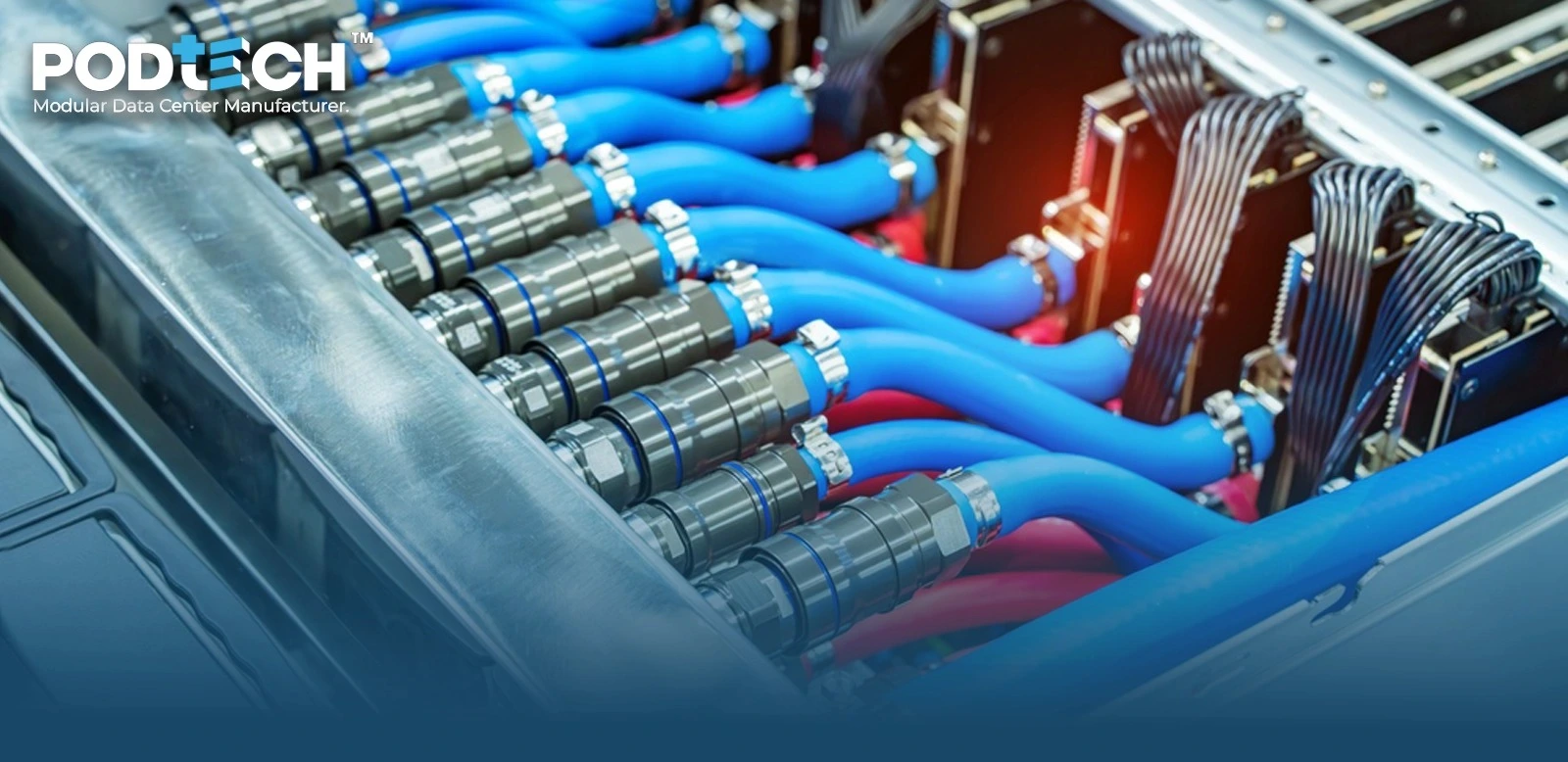
Liquid cooling has moved from an emerging option to close to a practical necessity for the highest-density AI and high-performance computing workloads, where rack densities now regularly exceed what air cooling can manage efficiently. Lower-density workloads and many existing enterprise deployments still run well on air cooling, so this is not a blanket shift for every AI data center. Direct-to-chip liquid cooling removes heat at the source, reducing the burden on room-level cooling infrastructure and improving efficiency even in high ambient conditions. For new high-density AI deployments in the UAE, liquid cooling is increasingly built into the design from day one instead of being added later as a retrofit.
Containment strategies, including hot aisle and cold aisle containment, remain fundamental regardless of the primary cooling technology chosen. Proper containment prevents hot and cold air from mixing, which improves the effectiveness of whatever cooling system sits behind it and reduces the total cooling capacity a facility needs to install. In a climate where every degree of cooling capacity carries a real cost, containment is one of the more cost effective interventions available.
Redundancy design also needs to reflect local operating conditions. Facilities serving government, banking, or disaster recovery functions in the region often specify N plus 1 or 2N cooling redundancy, though the right level depends on the facility’s tier classification and workload criticality rather than a fixed rule. Wherever redundant capacity is used, its sizing has to account for the fact that ambient conditions here push equipment closer to its rated limits more often than in temperate markets. Redundant capacity calculated using temperate climate assumptions can leave a facility with less real-world headroom than the design suggests on paper.
Modular Data Center design and site-specific adaptation in UAE
One pattern that holds up consistently across GCC deployments is the advantage of modular data center construction when it comes to climate adaptation. Modular facilities can be engineered and pre-configured for a specific site’s ambient conditions, dust profile, and humidity pattern before deployment, so the design fits the site from the start instead of being adjusted after the fact in the field. This matters more in the UAE than in most markets because the difference between a coastal site in Dubai and an inland site near the Saudi border is significant enough to change which cooling approach performs best. Because units are built and tested before arriving on site, cooling performance issues tied to climate mismatches also tend to surface and get corrected earlier than in a traditional build, where cooling systems are often finalized late in a longer construction timeline.
Operational practices that matter as much as equipment choice
Equipment selection is only part of the picture. Filtration maintenance schedules in the UAE need to run more frequently than manufacturer defaults calibrated for cleaner climates, since facilities that stick to standard replacement intervals tend to see airflow degradation and higher energy consumption well before the scheduled maintenance window.
Humidity monitoring also needs to be handled site by site instead of standardized across a portfolio, since a facility in Abu Dhabi and a facility in Al Ain can require materially different humidity control setpoints and dehumidification strategies even if they are otherwise identical in design. Water management, where any water-based cooling is used, benefits from tracking WUE alongside PUE instead of optimizing for energy efficiency in isolation, since a facility that improves PUE by leaning harder on evaporative or water-cooled systems may be trading one operating cost and risk for another in a region where water reliability and cost are not guaranteed.
Monitoring and controls tuned for local conditions
Sensor placement and control logic also need to reflect regional realities instead of following default configurations imported from other climates. Standard sensor layouts developed for temperate data halls can miss localized hot spots that form more readily under Gulf ambient loads, particularly in high-density zones running liquid cooling alongside air-cooled racks, so denser sensor coverage calibrated to the site’s actual operating range helps catch drift early. Staffing matters just as much. Technicians used to cooler markets can underestimate how quickly a filter change or coolant top-up needs to happen once ambient conditions push past 45 degrees Celsius, so maintenance schedules and training built around Gulf conditions, rather than manufacturer defaults from elsewhere, tend to close the gap between a facility’s designed performance and what it delivers day to day.
Where this leaves operators in the region
No cooling technology works for all data centers within the UAE because the environment itself is not homogeneous. The optimal approach will depend on whether the data center in question is located near the coast or in the interior, as well as the required density of workloads, tolerable dependence on water sources, and the desired degree of redundancy. Facilities which have shown themselves capable of functioning during the heat of a Gulf summer differ from those which struggle precisely because of the approach they take to their cooling system design, rather than a specific technology.
With more AI-based workloads and high-density computing in the area, the need for cooling design is going to become even greater. Facilities built today with high ambient equipment ratings, appropriate containment, thoughtful water strategy, and liquid cooling readiness will be better positioned to handle that growth than those retrofitted after the fact. Cooling strategy is not a secondary consideration behind IT infrastructure. It is one of the primary factors that determines whether a facility performs as designed once summer arrives.
FAQ
What is the best cooling method for a data center in the UAE?
There are no methods that can be used in all locations within the UAE. Locations near coastlines with high humidity levels may benefit from indirect evaporative cooling combined with the mechanical backup system. Inland locations with lower humidity and wider temperature variations will benefit from mechanical cooling with a high ambient rating.
Why doesn’t standard evaporative cooling work well in the UAE?
The process of evaporative cooling relies upon wet bulb temperature being very low for efficiency rather than the mere low humidity levels alone. During the summer season in the Gulf area, particularly on the coastline, the wet bulb temperature is sufficiently high that evaporative cooling systems fail to offer much cooling potential when it is required most.
Is liquid cooling necessary for data centers in the UAE?
For high-density workloads like AI training and inference, liquid cooling is becoming close to a requirement, not just an optional upgrade. Air cooling struggles to keep up with the heat output of modern high-density racks, and liquid cooling removes heat more efficiently at the source, which matters even more in a climate where ambient air is already hot for most of the year. Liquid cooling targets the cooling to the source. This is the key to enabling PUE closer to 1.1-1.2.
How does dust affect data center cooling in the region?
Sand and dust carried by air clog up the filters much more quickly than in other regions, which leads to decreased flow rates and increased service intervals. Those companies that operate on the same manufacturer’s filter-changing schedule that is tailored to other markets usually suffer from a decrease in efficiency before their next planned service.
What is PUE and why does it matter in hot climates?
The ratio of power usage efficiency (PUE) is the ratio of the energy consumed by the facility for operating IT equipment and that used on overhead costs such as cooling. In hotter areas, such as the UAE, the energy consumed in cooling forms a greater percentage of total energy consumed as opposed to areas in a milder climate, therefore, making PUE more relevant.
Does data center cooling design differ between coastal and inland UAE sites?
Yes. There are many coastal cities in the UAE that have very humid weather for most of the year, whereas there are some places like Al Ain where the weather is drier, and the temperature difference between daytime and nighttime is greater. There would be different cooling systems for both kinds of conditions, as a cooling system designed for one cannot be effective in another.
Can modular data centers handle UAE climate conditions better than traditional builds?
Engineered modular data centers allow cooling systems to be designed based on the climate at hand before deployment since they are tailored to the exact climate conditions. This helps to avoid problems related to climate conditions that usually occur after the installation of conventional buildings, where such considerations are generally made.