
It is 9 a.m. on a Tuesday. Your team opens the dashboard and gets nothing. The CRM will not load. Six hours of orders are gone. The data center your business has depended on is offline, and the person on the phone from your provider has no ETA.
I have spoken to people who have been in that room. They describe it less like a technical failure and more like a physical sensation. You start running the mental calculation of what this hour costs, and then the next one, and then you stop because the number gets too uncomfortable to finish.
What most of those businesses had in common: they had a backup. What they did not have was a disaster recovery plan anyone had actually run through. That gap is what separated the companies back online the same day from the ones still untangling the mess three weeks later.
The Backup Is Not the Plan
A backup is a copy of your data. Data center disaster recovery is what you do with that copy when your primary environment is gone. It includes the secondary infrastructure, the tested failover process, the communication plan, and the clear definition of who does what when the alert goes off at 2 a.m.
A backup with no recovery plan is a spare tyre with no jack. The part you need is technically there. It just will not help you when you are stranded. Across the GCC, where cloud and colocation adoption is high, the assumption that the provider handles recovery automatically is one of the most expensive misconceptions in regional IT.
The GCC Has Raised the Stakes
Saudi Arabia is channelling billions into cloud and AI under Vision 2030. The UAE’s AI Strategy 2031 has made the country a genuine regional technology leader. Qatar, Kuwait, Oman, and Bahrain are all accelerating their own digital economy agendas. Hyperscalers including Microsoft, AWS, and Google Cloud have established meaningful infrastructure presence across the Gulf, drawn by free zones like Dubai Internet City, Abu Dhabi Global Market, and NEOM-adjacent corridors in Saudi Arabia.
That growth creates exposure. The faster a digital ecosystem expands, the more every business inside it depends on the physical infrastructure beneath it. A failure at that layer does not stay contained. It cascades.
Regulators have noticed. Financial services firms in the UAE answer to CBUAE and DFSA business continuity requirements. Healthcare organisations comply with DOH and HAAD standards. Saudi Arabia’s National Cybersecurity Authority requires documented recovery planning with testable RTO and RPO targets. Across the GCC, a recovery plan that exists only on paper no longer counts.
The Cloud Is Still Physical. People Keep Forgetting That.
Every cloud service, every AI model, every SaaS platform runs on a physical server in a physical building. When that building is compromised, the virtual layer on top of it fails with it. Cloud availability zones mitigate this in ordinary failure scenarios. What they are not designed for is concurrent disruption across multiple zones or regions, which is exactly what happened to businesses depending on Gulf-based cloud infrastructure in early 2026.
Data center resilience means protecting the physical layer, not routing around it. Real hardware. A real secondary location. Configured, tested, and ready. Not planned for next quarter.
The Two Numbers Your Recovery Plan Lives or Dies By
Every serious disaster recovery strategy starts with two measurements. The Recovery Time Objective (RTO) is the maximum your business can be offline before the damage becomes critical. The Recovery Point Objective (RPO) is how much data you can afford to lose, measured in time from the last clean copy. Modern continuous replication can bring RPO down to five or ten seconds. Getting both numbers wrong costs more than setting them right ever would.
A complete plan also needs:
- A secondary site within four hours of the primary data center, reachable if connectivity fails.
- Redundant hardware at N+1 or higher, mirroring the primary environment.
- A tested failover process with assigned roles and practiced communication protocols.
- Live condition monitoring across power, cooling, temperature, and humidity.
Why Modular Data Centers Make Practical Sense
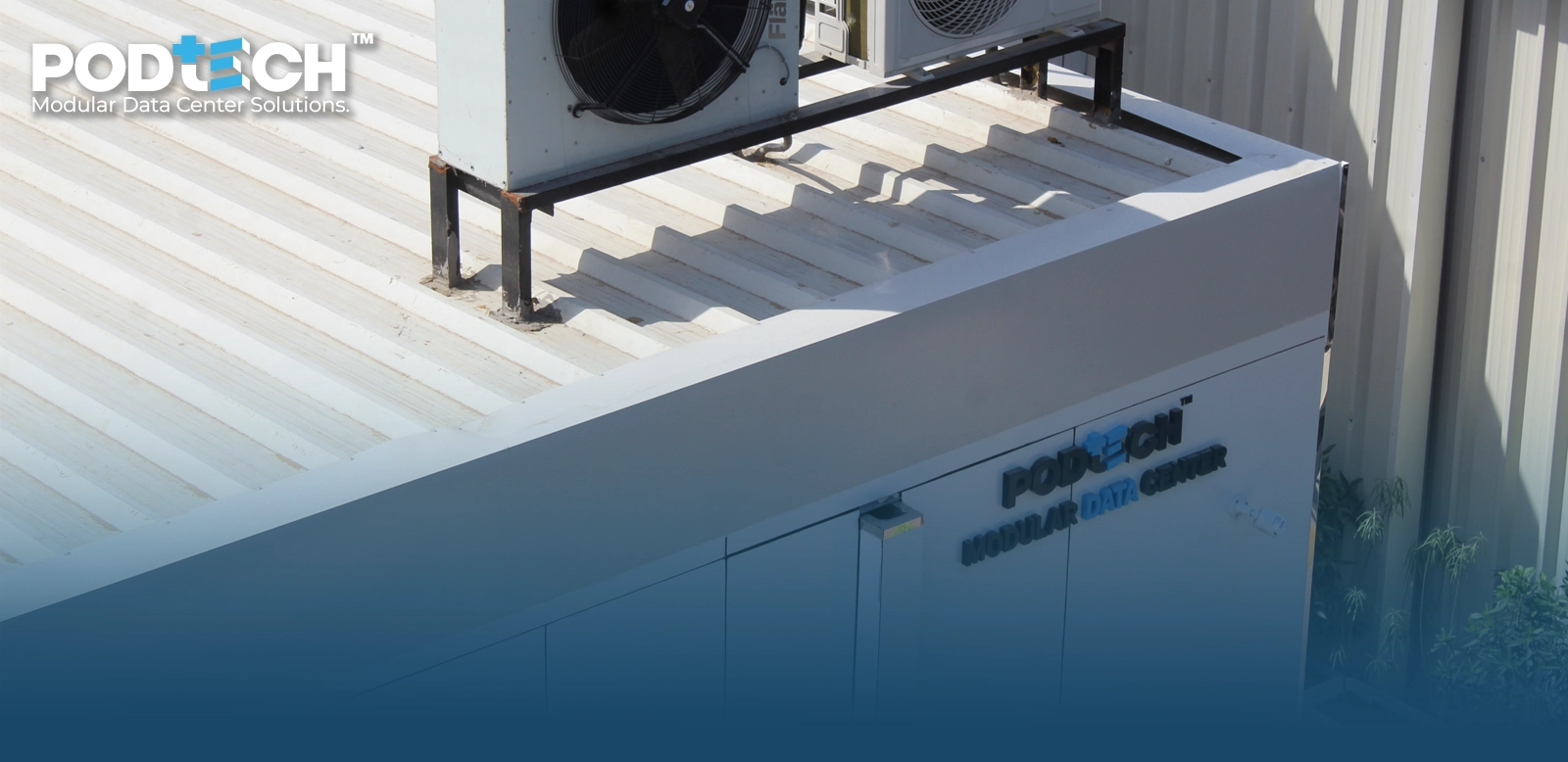
The traditional secondary site options, building a permanent facility or leasing colocation space, carry significant cost and lead time. A modular data center changes that calculation. These are factory-built, self-contained units with power, cooling, networking, and fire suppression pre-integrated. Setup is measured in hours. Capacity scales by adding units, not building facilities.
Podtech Data Center designs and manufactures modular infrastructure at their UAE facility, serving clients across the UAE, Saudi Arabia, Bahrain, Kuwait, Qatar, Oman, and wider MENA markets including Algeria, Morocco, and Tunisia. Solutions are engineered to Tier III and IV standards across three configurations:
- Micro Data Centers for smaller businesses and remote sites needing high reliability with a minimal footprint.
- Hyperscale Modular Solutions for large enterprises requiring dense, redundant, centrally managed infrastructure.
- Edge Data Centers for IoT, smart city, and real-time applications where latency across the Gulf matters.
Each unit connects via satellite uplinks, 5G, or mesh networks. When regional infrastructure is disrupted, they operate independently. That independence is the point.
Act Before the Tuesday That Changes Everything
The companies that survive infrastructure crises intact are not the ones with the best emergency response on the day. They are the ones that made a deliberate decision, months earlier, to treat recovery infrastructure as a business requirement. They ran the simulations. They built the secondary site. They knew the numbers.
Across the GCC, where digital infrastructure is growing faster than almost anywhere in the world and regulatory expectations are tightening, that decision is no longer optional. The infrastructure exists to get this right. The only question is whether your business acts before or after it finds out the cost of waiting.
Frequently Asked Questions: Disaster Recovery in the UAE and GCC
These are the questions businesses across the Gulf ask most when they start taking data center disaster recovery seriously.
What is data center disaster recovery and why does it matter in the UAE?
What is the difference between a data backup and disaster recovery?
What are RTO and RPO, and how do I set them?
How do modular data centers support disaster recovery across the GCC?
What are the resilience and recovery requirements for businesses in the UAE and Saudi Arabia?
Where does Podtech Data Center operate in the GCC and MENA?
Learn more about Podtech Data Center’s modular disaster recovery solutions at podtechdatacenter.com.