
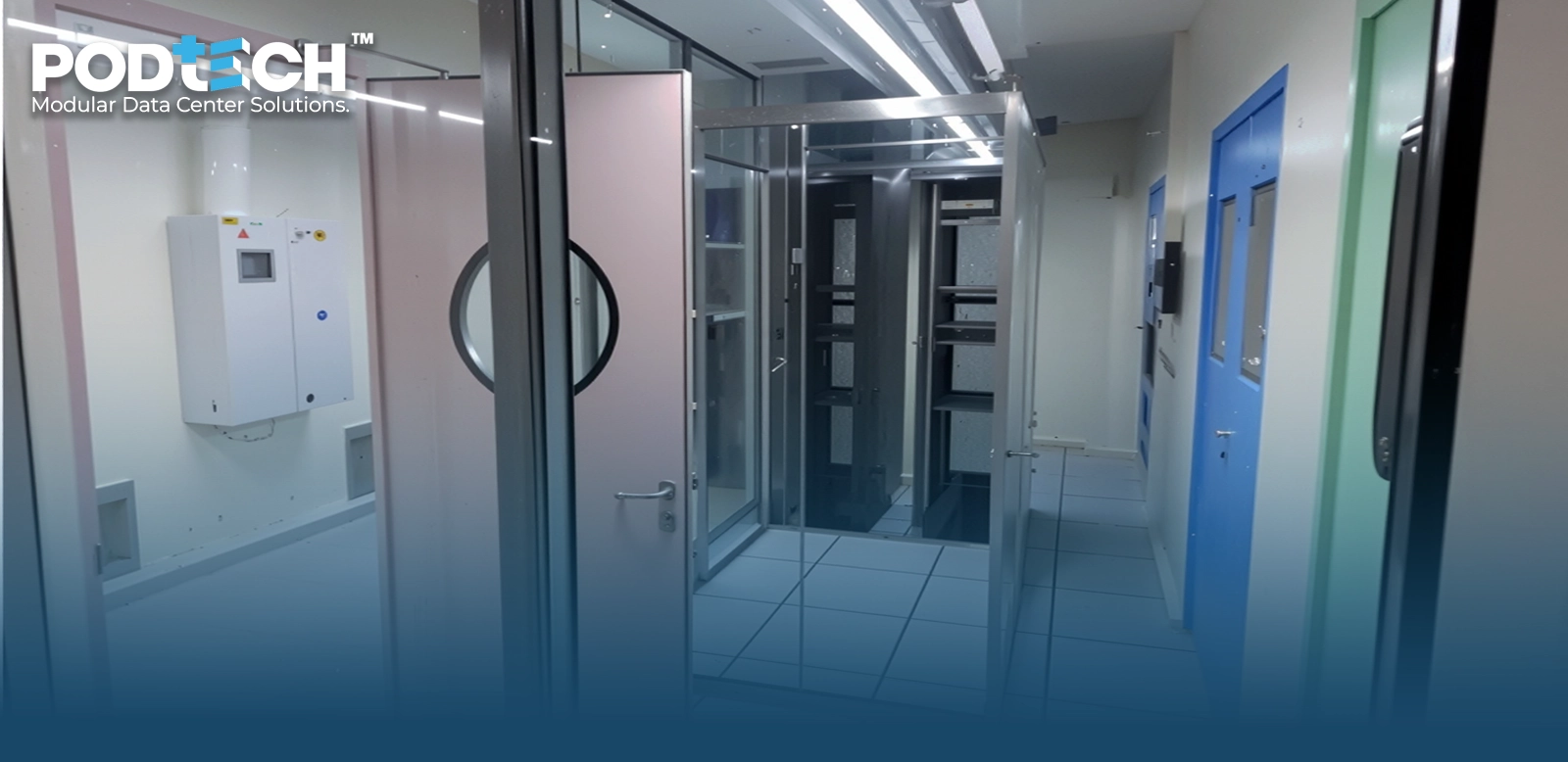
PodTech Data Center is a UAE-based modular data center manufacturer that designs, engineers, and produces prefabricated data center infrastructure for enterprise, government, and telecom operators across the GCC, North Africa, and Nigeria. The company builds complete, factory-integrated units that are shipped to site ready to be connected and commissioned, rather than constructed in place. Every solution PodTech delivers is built around one core product: the Podule.
The Podule is PodTech’s proprietary data center unit. At its core is a precision-engineered modular steel frame that is configured to the client’s specifications rather than supplied as a fixed enclosure The Podule stands out because of its frame. You can adjust its internal height, stack another unit vertically on the same space, connect them horizontally to create a bigger system, and build it to fit the space you have. It comes pre-built, fully tested, and ready for use with all necessary features like power, cooling, networking, DCIM, fire suppression, etc., installed. The Podule is what PodTech builds, and this article explains how it works, what it contains, and where it fits into an organization’s infrastructure strategy.
The Problem With How Most Organizations Think About Data Centers
When most infrastructure teams consider building a data center, they always envision a construction project involving permits, site preparation, months of civil work, procurement of equipment, and long commissioning periods. Often, it takes nearly two years before any workload goes live. That model made sense when digital demand grew incrementally. It no longer fits the pace at which organizations in the GCC and across Africa are being asked to expand their compute capacity.
The demand side has changed. The supply side, for many buyers, has not kept up. That gap is where modular data center infrastructure enters the picture, and where PodTech Data Center’s Podule was designed to operate.
What the Podule Actually Is
The Podule is PodTech’s modular data center unit. It’s a factory-built, weatherproof box that is deployed at your site with everything you need: power, cooling, networking, fire suppression, and environmental monitoring. The systems within are built, set up, and tested before they leave the factory.
So, when our Podule gets to your location, you only have to worry about the connection of the unit to stable power and commissioning. That distinction matters considerably for organizations working against tight timelines or operating in locations where traditional civil infrastructure is limited.
As a modular data center provider, PodTech builds the Podule to operate as a standalone unit or as part of a larger multi-pod campus. One Podule is perfect for remote edge sites, disaster recovery data centers, or simply replacing an old enterprise server room. When you interconnect several Podules, you’ve got a scalable, high-density data center ready for big workloads and heavy-duty AI tasks.
End-To-End Fully Integrated Modular Data Center: What’s Included?
The integration inside a Podule covers the systems that would otherwise require separate procurement, installation, and coordination across multiple contractors. Each unit includes:
- Power infrastructure: Includes high-efficiency UPS systems that hit over 97% efficiency, along with integrated distribution boards and generator-ready input options.
- Precision cooling: Dynamic environmental management based on the unit’s unique thermal load with air and liquid cooling options based on rack density needs.
- Fire detection and suppression: Automatic, integrated at the unit level, independent of the surrounding building fire infrastructure.
- Structured networking: Cabling infrastructure and rack systems pre-wired to accept server and networking equipment upon arrival.
- Environmental monitoring and DCIM: Centralized management with real-time alerts via dashboard, email and telephone. Remote monitoring capability comes as standard.
- Physical security: Multi-factor access controls, tamper-resistant construction, access audit logging built into the enclosure itself, manholes CCTV monitoring etc.
The enclosure is rated for up to IP68 and designed for seismic resiliency. This reflects PodTech’s design for use in environments where building infrastructure is not reliable, the climate is moderate, and there is access to existing logistics networks.
Vendor-Agnostic Approach: Its Impact On Data Center Construction
One of the more impactful design decisions PodTech made with the Podule is that it does not lock customers into a particular server, GPU or networking vendor. The unit is configured to accept equipment from any manufacturer, which gives buyers the freedom to source compute and networking hardware through their existing procurement relationships or based on current availability.
This is particularly relevant for organizations deploying AI workloads. GPU infrastructure is one of the most supply-constrained categories in enterprise technology at the moment, and buyers who have secured access to specific hardware cannot afford for their data center deployment to be tied to a single vendor’s roadmap. A vendor-agnostic enclosure removes that dependency.
The same logic applies to networking and power equipment. PodTech’s role as the modular data center manufacturer is to deliver the facility layer: the physical environment in which the customer’s chosen technology operates. That separation of responsibility gives operators more control over their infrastructure over time.
Scalability: From One Pod to a Multi-Pod Campus
The Podule is designed as a building block. A single unit serves organizations that need a defined, manageable infrastructure footprint at a specific location. Interconnected Podules serve organizations that need capacity to grow without redesigning their infrastructure from scratch.
In a multi-pod configuration, additional units are added to the campus as demand increases. Each new Podule connects to the existing setup rather than requiring the existing infrastructure to be replanned. Power, cooling, and management systems scale with the number of units rather than requiring a rip-and-replace cycle when capacity thresholds are reached.
This model is particularly well-suited to organizations in markets where predicting long-range compute demand with precision is difficult. Governments rolling out digital public services, telecom operators expanding 5G edge infrastructure, and enterprises managing rapid regional growth often find that their infrastructure needs in three years look quite different from what their planning documents projected. Modular scalability provides a way to respond to that reality without incurring the full capital commitment of a large traditional build upfront.
Where Podules Are Being Deployed
PodTech is the best platform for organizations in UAE, Saudi Arabia, Kuwait, Qatar, Oman, Bahrain and North Africa including Nigeria and the entire MENA region. The use cases are different, but the conditions for deployment share common features: urgency, environmental challenge or both.
Edge deployments place Podules close to the point of data generation, reducing latency for real-time applications in industrial, telecom, and smart city contexts. Disaster recovery deployments use Podules as secondary sites that can be brought online rapidly following an outage at a primary facility. Enterprise deployments replace aging server rooms with infrastructure that meets current standards for power efficiency, redundancy, and security without the time and cost of a traditional construction project.
The weatherproofing and environmental hardening in each Podule make outdoor and semi-permanent deployment practical in the Gulf’s climate, where summer ambient temperatures exceed 45 degrees Celsius and humidity management is a serious operational consideration.
What Separates a Modular Data Center Manufacturer From a Distributor
There is a meaningful difference between a company that designs and manufactures modular data center infrastructure and one that assembles or resells prefabricated enclosures from a third-party vendor. PodTech operates as a manufacturer, which means the engineering decisions that determine how a Podule performs, how it holds up under stress, and how it can be configured are made internally.
That matters when buyers are specifying infrastructure for high-stakes deployments. Custom configurations, non-standard power or cooling requirements, atypical site conditions, or specific compliance obligations all require direct engagement with the organization that designed the product, not an intermediary passing requirements upstream to an unknown manufacturer.
PodTech constructs modular data centers in the UAE, also meaning that logistics for GCC and regional African deployments are handled with established regional experience. Shipping routes, customs processes, and on-the-ground deployment support across these markets are part of the operational picture PodTech has built.
Global Standards, Regional Deployment
Every Podule is built to comply with international transport and infrastructure standards, which allows units to be shipped and commissioned anywhere PodTech serves without the product requiring country-specific re-engineering. This consistency is important for organizations that operate across multiple markets, or that want to duplicate infrastructure across sites in different jurisdictions.
Meanwhile, PodTech’s work is focused on markets with particular infrastructure characteristics, such as the reliability of the power grid in different parts of the GCC, the developing connectivity infrastructure across parts of Africa, and the changing geopolitical conditions across the broader Middle East that has made infrastructure resilience more of a consideration than five years ago. That’s why the Podule is designed with these realities in mind rather than as edge cases.
The Insight From PodTech
The Podule was developed from a consistent observation: organizations in the GCC and Africa are being asked to deploy compute infrastructure faster than traditional construction allows, in locations where traditional construction may not be viable at all. The unit exists to close that gap.
Modular data center infrastructure is not a compromise version of a traditional data center. When it is engineered correctly, it is a more practical form of the same infrastructure, built for the deployment conditions that actually exist rather than the idealized conditions that traditional design assumptions were built around.
The Podule is PodTech’s answer to that requirement. It is factory-built, fully integrated, vendor-agnostic, scalable, and designed to operate in the environments where it is being deployed. For organizations evaluating modular data center manufacturers for their next infrastructure project, the quality of the product matters as much as the speed of delivery.